SaaS localization
that ships with your features,
reviewed by your whole team
Prismy brings localization into your dev workflow. Detect missing translations on every release, generate them with AI, and let PMs and reviewers polish the wording in the webapp or live in the product. Developers stay focused, releases stay on schedule.
92% translation accuracy out of the box
|
4.9/5 on G2
Localizing a SaaS product shouldn't slow down your releases
Without Prismy, every release waits on localization
| # | What goes wrong | The impact |
|---|---|---|
| 1 | Translation starts only after the feature is merged | Features ship in one language first, then wait for a separate localization pass. |
| 2 | Developers copy strings into spreadsheets or a separate TMS | Manual sync breaks, strings drift, and someone has to maintain the pipeline. |
| 3 | Generic machine translation ignores your product terminology | Reviewers rewrite most of the output, so the time you saved disappears. |
| 4 | PMs and reviewers can't edit copy without a developer | Every wording tweak becomes a ticket, a PR, and a context switch for an engineer. |
| 5 | Nobody can answer 'are we ready to ship in German?' | Translation status is scattered across Git, spreadsheets, and Slack. |
With Prismy, features ship already translated
| # | What happens | The difference |
|---|---|---|
| 1 | Prismy detects new and changed strings on every pull or merge request | Your team gets an instant signal: what's missing, in which languages. Generate it in one click. |
| 2 | AI translates with your glossary, brand voice, and past approvals | 92% accuracy out of the box. Reviewers polish the wording instead of rewriting it. |
| 3 | PMs and reviewers edit copy in the webapp or live in the product | The Chrome extension lets anyone fix wording WYSIWYG, directly in the running app. |
| 4 | Prismy validates i18n syntax on every save | Non-devs can't break variables, plurals, or HTML tags. Engineers stop reviewing copy. |
| 5 | Connect your repository once | Files stay in your stack. No sync scripts, no separate platform to maintain. |
Localization keeps pace with your release cadence, and your whole team owns the wording.
SaaS localization that fits how your team already ships
Prismy lives inside your existing workflow. Developers work in Git, PMs and reviewers work in the webapp and the browser, and the AI keeps every language in sync, release after release.
Localization built into your dev workflow
Prismy detects missing translations on every pull request and merge request, with no manual export.
Connect your GitHub or GitLab repository and Prismy watches every pull request and merge request for new or changed strings. When something is missing, it comments with the exact keys and languages, and one click generates the translations. Developers never leave their workflow, and no feature ships in a single language by accident.
AI translations tuned to your product, with 92% accuracy
Your glossary, brand voice, and translation history feed every generation, not generic machine output.
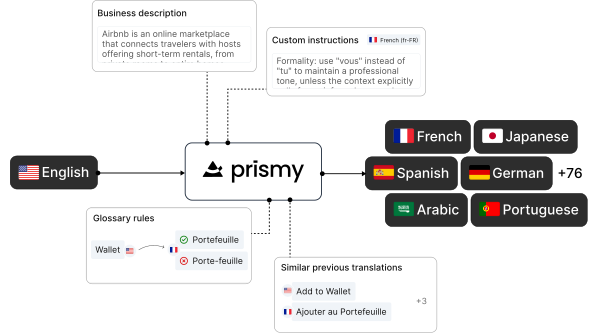
Prismy's AI translates using your company glossary, custom instructions written by your PM, and the context of every translation your team has already approved. The result is 92% translation accuracy out of the box, so reviewers spend their time polishing wording instead of rewriting it from scratch. Quality holds as you scale from two languages to ten.
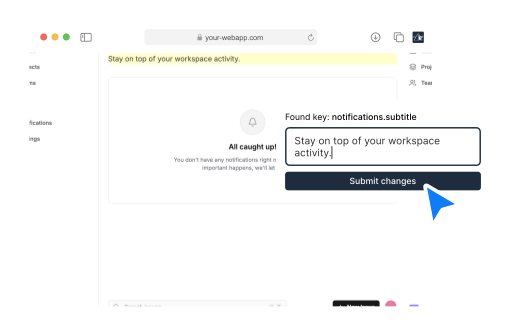
PMs and reviewers own the wording, live
Edit copy in the webapp or directly in the running product with the Chrome extension. No developer, no ticket.
Wording is no longer a developer task. PMs, content leads, and reviewers edit copy in Prismy's webapp, or use the Chrome extension to fix wording WYSIWYG-style directly in the live product. Changes flow back to your repository through clean, conflict-free pull requests. UX writers can even manage copy from Figma. Everyone works where they already are.
Catch translation issues before they ship
Syntax validation and release checks keep broken or untranslated strings out of production.
Prismy's editor enforces i18n syntax on every save, so non-developers can never break variables, pluralization rules, or HTML tags. Add Prismy's status check to your pipeline to block a release until the required languages are translated and approved. Translation quality stops being something you discover in production.
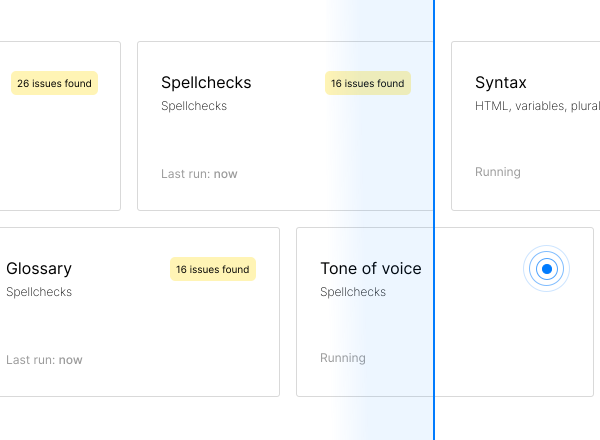
See exactly where every language stands
One dashboard shows what's translated, what needs review, and what's blocking the release.
Instead of chasing status across Git, spreadsheets, and Slack, your whole team sees translation progress in one place. PMs know at a glance whether the product is ready to ship in French, German, or Japanese, and reviewers know exactly which strings still need them. Setup takes minutes and your translation files stay in your own stack.
How SaaS localization works with Prismy
1
Connect
Link your GitHub or GitLab repository and pick your translation files. Prismy syncs automatically from that point on.
2
Detect and translate
Every release is scanned for missing strings. Prismy flags them and generates AI translations in one click, using your glossary and brand voice.
3
Review
PMs and reviewers polish the wording in the webapp or live in the product with the Chrome extension. Syntax stays protected automatically.
4
Ship
Translations merge back as clean pull requests. Your feature ships in every language, on the same release.
Built for fast-shipping SaaS teams
Your next release ships in every language.
Connect your repository in minutes. Prismy detects missing translations on every release, generates them with 92% accuracy, and lets your whole team review the wording without a single developer ticket.
Frequently asked questions
SaaS localization is the process of adapting a software-as-a-service product into multiple languages, including the interface copy, in-app messages, emails, and help content, so it feels native to users in each market. For teams that ship continuously, the hard part is keeping every language in sync with frequent releases. Prismy handles this by detecting new strings on every release and translating them automatically, so localization keeps pace with development.
The best SaaS localization platform is the one that fits how your team ships. If you release continuously and want localization to keep up without slowing developers down, Prismy detects missing translations on every pull request, generates them with your glossary and brand voice, and lets PMs and reviewers edit copy without involving engineers. Tools like Crowdin, Lokalise, and Phrase are project-oriented and put the whole team into a single heavy platform.
Prismy connects to your GitHub or GitLab repository and analyzes every pull request and merge request. When a release introduces new or changed strings, Prismy detects which translations are missing across your active languages and lets you generate them in one click. There is no manual export, no batch handoff, and no separate localization pass after the feature ships.
Prismy reaches 92% translation accuracy out of the box because it does not rely on generic machine translation. Every translation uses your company glossary, custom instructions written by your product team, and the context of all the translations your team has already approved. Reviewers spend their time polishing the wording rather than rewriting it.
Yes. PMs, content leads, and reviewers edit copy in Prismy's webapp or directly in the live product with the Chrome extension, WYSIWYG-style. Changes flow back to your repository as clean, conflict-free pull requests. Prismy validates i18n syntax on every save, so non-developers can never break variables, plurals, or HTML tags.
Yes. Prismy is stack-agnostic and reads your existing translation files, whatever framework or i18n library you use, including React, Vue, Next.js, and custom setups. There is no migration and no new file format to adopt. Your translation files stay in your own repository.
Crowdin, Lokalise, and Phrase are mature translation management platforms built around translation projects and a single shared workspace. Prismy is built around continuous SaaS releases: it lives inside your Git workflow, gives each role its own surface (Git, webapp, Chrome extension, Figma), and translates with your product's glossary and voice. There are no sync scripts to maintain and no per-seat learning curve for the whole team.
Setup takes minutes. Connect your GitHub or GitLab repository, select your translation files, and Prismy starts detecting and syncing translations automatically. There are no scripts to write, no webhooks to configure, and no CI pipeline step to maintain.
Why SaaS teams switch to Prismy
Most SaaS localization tools were built for translation projects, not continuous releases. Here is how Prismy is different from agencies, legacy TMS platforms, and dev-only tools.
Localization keeps up with continuous releases.
Agencies and project-based platforms like Phrase or Crowdin run on cycles that don't match weekly SaaS releases. Prismy detects and translates new strings on every pull request, so localization happens continuously instead of in a batch after the fact.
Your whole team contributes, not just the developer.
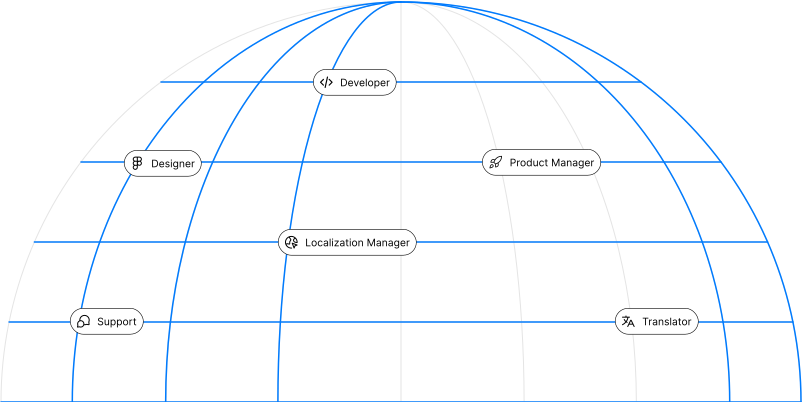
Dev-only tools give engineers a CLI and leave everyone else out. Crowdin and Lokalise put the whole team into one heavy platform. Prismy gives each role the right surface: Git for developers, the webapp and Chrome extension for PMs and reviewers, Figma for UX writers.
AI translations tuned to your product, not the internet.
The default machine translation inside Lokalise and Crowdin ignores your terminology. Prismy translates with your glossary, brand voice, and full translation history for 92% accuracy out of the box, so reviewers polish instead of rewrite.
No sync scripts to build and maintain.
Lokalise, Crowdin, and Phrase all expect you to set up and maintain the sync between your repository and their platform. Prismy connects once and handles it automatically, with your files staying in your own stack.
Translators and reviewers work with full context.
Other tools move strings into a separate editor with no link back to the feature. Prismy attaches the pull request description, screenshots, and Figma links to every key, so reviewers see exactly what they are translating.
No agency lead times or per-word invoices.
Translation agencies add days to every release and bill per word. Prismy generates translations instantly and lets your own team review them, so cost and turnaround stop scaling with the number of strings.
Rated 4.9/5 on G2.
Teams that move from Crowdin, Lokalise, Phrase, or an agency consistently cite faster releases and fewer developer interruptions. Prismy holds a 4.9/5 rating on G2.
SaaS localization that keeps up with your releases.
Connect your repository, detect missing translations on every release, and let your whole team ship in every language without the coordination tax.
Go global, the simple and powerful way.


Go global, the simple and powerful way.