October 15, 2025 · Interview
Survey: Mental health in tech teams - are we talking about it?
In tech, 73% of developers have experienced burnout, caught in the myth of the '10x developer' and the pressure to 'always do more'...
In the United States, 73% of developers admit to having experienced an episode of burnout. Yet, the topic is rarely brought to the table in a heavily male-dominated universe that leaves little room for vulnerability.
Are you familiar with the myth of the "10x developer," that fantasized archetype of the solitary genius with exceptional productivity, coding day and night to "carry" their team? The expression originated in the 1960s-70s, when studies (for example, those by Sackman, Erikson & Grant, 1968) showed very significant performance gaps between programmers (time to code a task, number of bugs, efficiency).
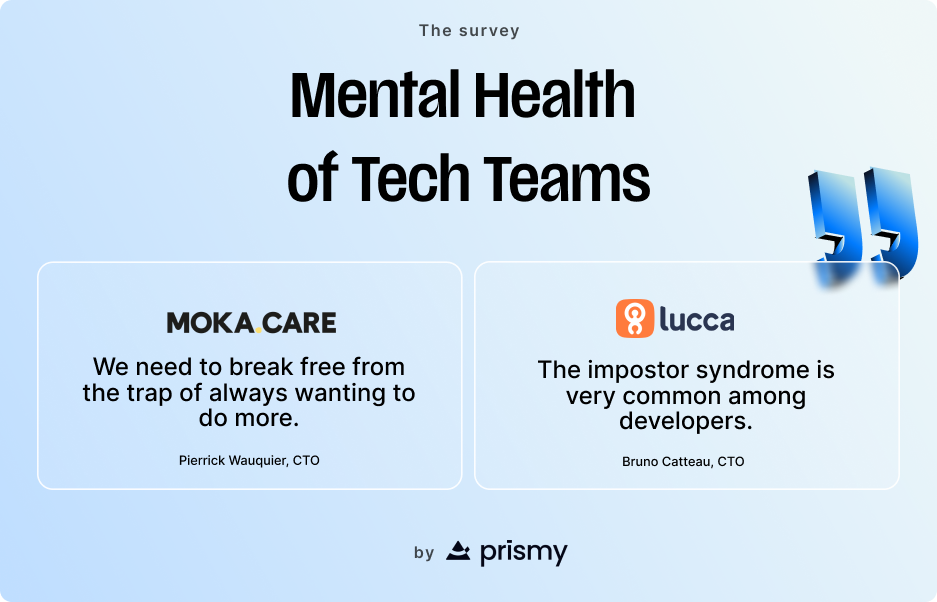
A myth that still resonates in the daily lives of many developers, including the most junior ones who sometimes suffer from impostor syndrome. "It's a trap I've experienced myself: how to try to do more and more, when the real question is how to do better," emphasizes Pierrick Wauquier, CTO of moka.care, a workplace mental health company.
A view shared by Bruno Catteau, CTO of Lucca: "Impostor syndrome is very prevalent among developers. It's a population where excessive humility is common: 'if it works, it's thanks to others, but if it fails, it's my fault.' As a result, successes are rarely highlighted. It's a shame, because when they feel in a climate of trust, developers are receptive to these issues."
AI: friend or foe of mental health?
The temptation to measure productivity with metrics such as the number of lines of code produced, contributions, or time spent reviewing others' code can be further exacerbated with artificial intelligence. "With AI, we can fall even more into this trap of rapid productivity when in reality we spend a lot of time correcting errors. It's an interesting tool but used wisely," continues Pierrick Wauquier.
Moreover, the deployment of artificial intelligence further accelerates the obsolescence of skills that particularly threatens tech populations. "We live in a 'BANI' world described as fragile, anxiety-inducing, non-linear, and incomprehensible. For tech teams, it accentuates uncertainty and directly weighs on mental health," argues Margaux Tancrède, reference psychologist at moka.care.
Breaking with isolation
To stem this dynamic, Pierrick Wauquier tells us he prefers a less individualistic approach, particularly regarding metrics. He thus closely monitors the performance of his team as a whole. The objective? To counter one of the most prevalent psychosocial risks within tech teams that very often work fully remote: isolation.
"Some developers may have very little daily social contact; in one case, a patient only saw people 'in the flesh' when dropping off their children at school. The absence of visual, lunch, or social breaks can lead some to remain seated for more than five hours straight, promoting musculoskeletal disorders and psychological distress," observes Margaux Tancrède, reference psychologist at moka.care. No visual breaks, no lunch breaks, no social breaks: some developers sometimes don't leave their seat for more than 5 hours straight, thereby creating musculoskeletal disorders. This physical and mental isolation then becomes a strong factor of psychological distress.
"Developers must constantly innovate, but permanent pressure can reduce the mental space necessary for creativity. In the long term, this affects cognitive abilities and can generate physical warning signals," regrets the psychologist.
Margaux Tancrède recommends simple routines to preserve mental and physical health:
- 20-20-20 rule: every 20 minutes, 20 seconds break, look 20 meters away → reduced visual fatigue.
- Real screen-free breaks (lunch, walk, breathing, stretching), hydration, disconnection rituals (music, activity marking end of day).
- When working remotely: close the computer and put it out of your visual field, to avoid compulsive reconnection and preserve your balance.
Be strong and stay silent
This infernal quest for "always more," Florian Marin, Senior Engineering Manager at Teads, also experienced it in the past until he went through an episode of burnout. "During one of my past experiences, there was no CTO and I reported directly to the CEO. At one point, I was asked to fire people, without any managerial support, any listening. Over time, my malaise ended up spilling over into my personal life," he recalls.
A rough patch that took him time to put into words until he regained his balance by moving to the south of France. "In addition to prioritizing sports time and personal moments, I also agreed to be accompanied by a psychologist, which we never talk about because it is perceived as a form of vulnerability (especially when you manage). Whereas for me it's the opposite: I'm taking control to get better," he adds.
At moka.care, it's interesting to observe that among users who completed a first session with a psychologist, 19% are from tech teams compared to 25% for the rest of the population. For Margaux Tancrède, this difficulty in opening up about one's vulnerabilities is induced by constraining messages ingrained since childhood in this predominantly male population.
"Certain profiles, including introverted or perfectionist people, may be less inclined to ask for help or acknowledge their difficulties. In the context of tech teams, often symbolically and financially valued, this tendency can reinforce withdrawal, for fear of appearing to 'complain' when the situation seems favorable from the outside," observes the psychologist.
In its latest mental health barometer, moka.care more broadly observes that men often wait until the last moment to seek help, for fear of being perceived as weak or incompetent.
Psychological safety, a management question?
Whether it's tech teams or any other department, the observation remains the same: psychological safety remains the key for everyone to be able to express their difficulties and feel supported. For Florian, it's above all a management question: "I started my career at OCTO technology and I've never found such support elsewhere on the management side," he affirms.
This is precisely why he has endeavored to be attentive to his team through bi-monthly one-on-ones in which it's not about project follow-up but primarily about how the person feels within their team.
"I pay close attention to weak signals now that I've gone through this burnout episode myself. I'm convinced that if you feel good in your company, you can help it progress. My goal is not to pressure my teams to deliver more. For me, it doesn't work like that," he explains.
So, how can we improve the situation?
Within his team, Pierrick Wauquier emphasizes the importance of creating collective safeguards to avoid burnout. Work cycles are designed to integrate breathing space: six weeks of delivery, where new features are developed, followed by two weeks of "cool down." These periods are dedicated to cleaning, technical migrations, continuous training, and exploring new avenues. "It allows you not to keep your nose to the grindstone, to regain energy and curiosity," he emphasizes.
Each Friday afternoon is also dedicated to time for monitoring and experimentation: a way to maintain motivation and stimulate creativity. To combat isolation, projects are systematically handled in pairs, with regular rotation that allows everyone to work with different colleagues.
The team has also established a peer-to-peer coaching system: developers choose their coach, who is not necessarily their direct manager, and these coaches also participate in evaluations. "This creates a real network of trust, far from the pyramidal logic," specifies Pierrick. Transparency is pushed all the way to promotion decisions, discussed collectively, and in making salary grids available.
For its part, Lucca has implemented original arrangements: "We have established a trusted third party, outside of management and HR, that developers can consult occasionally for a specific difficulty: career progression, disagreement with the manager, or simply the need for perspective. It's someone who knows the company very well but reports to no one, which allows people to speak freely. The feedback is positive: several developers have returned with a more peaceful posture, more attentive."
So many practices that demonstrate that beyond technical performance, it is indeed psychological safety and the collective that allow teams to last.
--
Paulina Jonquères d’Oriola
Don't miss the next interviews!
Get the latest insights on localization, AI translations, and product updates delivered to your inbox.
No spam, unsubscribe at any time. We respect your privacy.
Go global, the simple and powerful way.