November 7, 2025 · Interview
Bloomays: the strategy behind its build vs buy choices
Loïc Calvy, CTO of Bloomays, explains how the company decides between building in-house and relying on existing solutions.
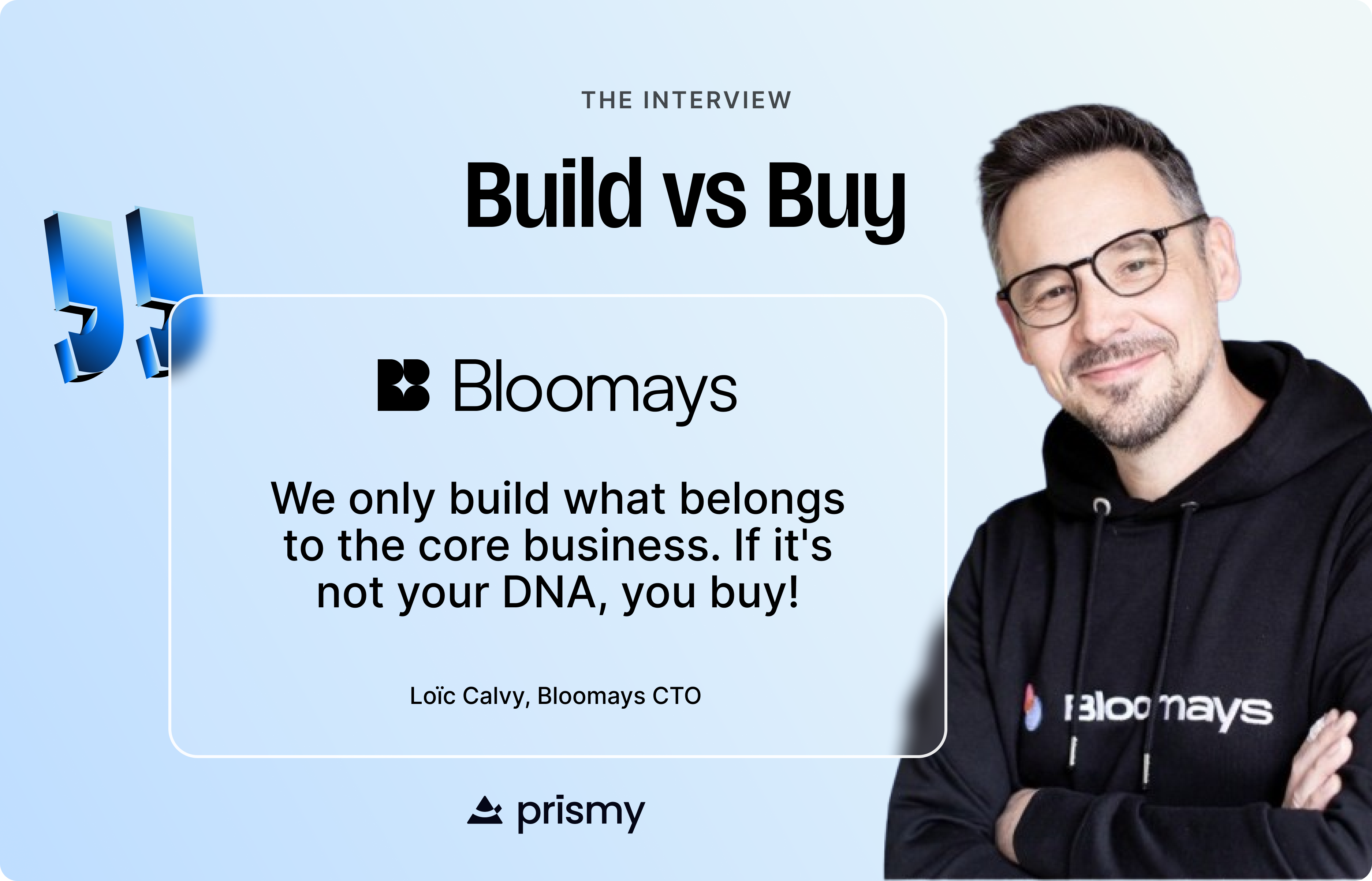
Co-founder and CTO of Bloomays, Loïc Calvy is a very hands-on leader. After completing an Executive MBA in 2020, he decided to launch his own entrepreneurial adventure with one conviction: the recruitment market deserved a better user experience. Today, Bloomays The Good Connection employs around twenty people (including about ten recruiters trained in tech roles) and operates on both freelancing and permanent contracts. Loïc looks back on his technical and business trade-offs between "build" and "buy."
What technical and business criteria guide your choices between developing a solution in-house or turning to a third-party tool?
Loïc Calvy: It's a recurring question, because profiles like mine, coming from engineering, tend to always want to build: we learned to develop, so it's our natural reflex. But very early on, I set a simple rule: we only build what belongs to the core business. If it's not your DNA, you buy!
At Bloomays, our stack is a patchwork of market solutions. We have an ATS to manage recruitment, a commercial CRM with HubSpot, an invoicing tool… All of that is buy. On the other hand, we built the workflow that orchestrates these bricks. Because what makes Bloomays valuable is the user experience: ensuring that a client has the same quality of interaction with one recruiter as with another. For that, we couldn't delegate the way we standardize our touchpoints.
Another key point is billing. In our business, we have a massive need for cash flow. I wanted to have full control over billing flows, check freelancers' working time, automate invoice issuance… That was too central to entrust to a market tool. So we built it. Same logic for our talent database: existing ATS didn't give us the flexibility we needed to describe skills the way we wanted.
How do you assess the real cost of "build" versus the cost of "buy"?
Loïc Calvy: Here, I stay quite classic. I break the needs down into user stories, assess the workload (small, medium, large tickets), then I multiply by the cost of resources. An internal developer paid €60K per year, costing €90K fully loaded, gives you a daily rate. If you outsource, you calculate based on the freelancer's day rate.
When you do that, you quickly realize that building costs much more. Obviously, you compare that to tools that cost €200 per month… You can't compete. But watch out: when you buy, you're building on a tool you may find hard to leave.
Concrete example: at the beginning of Bloomays, we chose a tool to manage our processes. After two years, we had to change it. Problem: we had stacked so many workflows tied to finance, customer care, etc., that unplugging it was extremely costly. That's the trade-off: buying is fast and efficient, but if you don't anticipate the exit, you can pay a hefty price later.
Does the AI wave change the way you arbitrate between build and buy?
Loïc Calvy: Yes, potentially. Until now, I always said, "if you can buy, buy." Because specialized companies will do better than you. But with AI and agents capable of coding for you, building becomes less expensive and more accessible. That could reshuffle the cards.
Already today, tools like Zapier, N8N, or Make have changed the game. Before, if a product lacked features or wasn't interoperable, we defaulted to building. Now, you can make your purchased solutions talk to each other very easily. That pushes even further toward buy.
Do you have any regrets about past choices?
Loïc Calvy: Yes: not documenting enough. When you build or interconnect several bricks, if you haven't written down what is plugged where, three years later you're stuck when it's time to unplug. That's what we experienced.
Today, we continue to buy massively, but we structure our integrations differently: if tomorrow we need to change a tool, it will take us a few months, not two years.
What advice would you give startups and scale-ups facing these choices?
Loïc Calvy: First: avoid FOMO. When you start looking at the market, you get dizzy because there are so many tools. Benchmark, yes. But you have to choose quickly and move forward.
Next: accept being ashamed of your V1. It will inevitably be imperfect, and that's a good thing. If you wait for the perfect solution, you'll spend two years building without releasing anything. Better to ship fast, even if it means adjusting later.
Finally: own your choices. Whether it's build or buy, these are five-year bets. A bad choice sticks for a long time. So it's better to be aware of it and live with it than to dream of a perfect tool that doesn't exist.
Don't miss the next interviews!
Get the latest insights on localization, AI translations, and product updates delivered to your inbox.
No spam, unsubscribe at any time. We respect your privacy.
Go global, the simple and powerful way.